

News
Batut: In Serbia, 220.000 people do not know they have diabetes
On the occasion of World Diabetes Day, Batut warns that a large number of people have this disease and are not even aware of it, because diabetes can go without symptoms for years.

"I will fight so that the killer's sister does not get custody, who said she was guilty of not killing my Olga herself." This is what Ljiljana Antić told "Blic" in 2017, who fought for her grandchildren after her daughter was killed by her husband. Seven years later, more than 200 femicides occurred in Serbia, according to data from the Autonomous Women's Center (AŽC).
According to FemPlatz data, ten femicides have been committed in Serbia since the beginning of 2024. According to the media, most of the femicides took place in Vojvodina, where there was no reaction from the provincial institutions.
Prema research According to the Center for Investigative Journalism (CINS), more than 300 femicides occurred in Serbia in 10 years. The research included 117 cases of femicide that were processed before the court. In the criminal proceedings, femicide is qualified as a crime of aggravated murder in less than half of the cases, while in other cases, as CINS writes, it is mainly a crime of murder or domestic violence with fatal consequences, for which a lower sentence is threatened.
However, femicide, as a gender-based murder committed against women, remains "invisible" in the context of family relationships and the consequences it leaves for children whose mothers are victims of femicide.
Ministries do not have data
The Ministry of Labour, Employment, Veterans and Social Affairs does not have data on children of femicide victims. Apart from this ministry, the Ministry of Family Care and Demography does not have statistical data either. The Republic Institute for Social Protection does not have data either. What this institution has is the number of victims of domestic violence.
The Autonomous Women's Center published the publication "The position and rights of children whose mothers are victims of femicide" in which they state that children, as witnesses of domestic violence, are often not recognized as victims of violence.
"This means that exposure of a child to family violence perpetrated against him by persons close to him is still not recognized or sanctioned as a special form of violence." Deficiencies in the existing normative framework regarding the general position and protection of victims of criminal acts certainly do not facilitate the provision of protection for children as a particularly sensitive category of victims, so harmonizing the legal framework with international standards is another important prerequisite for regulating the position of children whose mothers are victims of femicide." , the publication states.
For children whose mothers are victims of femicide, it is necessary to provide support in criminal proceedings and in the process of providing guardianship protection through specialized forms of assistance and support. This support should be based on an individual assessment of their specific needs, including psychological and psychosocial support, medical assistance and rehabilitation, as well as empowerment in the field of education and economic care, the publication states. For all the mentioned areas, and especially for the area of family relations, the lack of criteria defined by law for assessing the best interests of the child, as a starting point for decision-making in all matters concerning the child, stands out as a significant issue.
Protocols on the cooperation of institutions have been developed in European countries
The situation in five European Union member states - in France, Germany, Romania, Spain and Portugal - indicates that support services for child victims of femicide violence are "fragmented and often insufficient", and that it happens that children and other family members of immediate victims of femicide often remain "invisible" to the support system intended for recovery and protection from violence.
In Germany, Portugal and Spain there are developed protocols on cooperation between the police and services that provide psychological support in cases of femicide. Spain has one of the most comprehensive protection systems against gender-based violence, including femicide. During 2022, they established a system of recording all cases of gender-motivated murder of women and children, and the collection of statistical data on femicide and their analysis is carried out by several state bodies and non-governmental organizations. Also, in Spain, data on children who were left without parental care as a result of femicide, who were killed in domestic violence or who were present during the murder of their mother, are publicly available.
In these countries, children of femicide victims are recognized as direct victims of violence. Accordingly, support measures are provided for children whose mothers were killed in domestic violence.
The Center for Social Work has a key role in protecting children who are victims of violence
The issue of femicide, although it is becoming an increasingly visible social problem, is not particularly considered both in the normative context and in the protocols in the work of institutions of the social protection system, above all, centers for social work, says the assistant professor from the Department of Social Policy and Social Work of the Faculty of Philosophy in Niša Bojana Vranić.

"This social problem is considered within the framework of the topic of domestic violence and is normatively included in more detail in the Criminal Code, the Family Law, the Law on the Prevention of Domestic Violence... If we try to look at the minor children of mothers, victims of femicide, it is even more challenging. Namely, we are still waiting for expert views, that children are not victims only when violence is perpetrated against them, but also in situations where they witness violence (especially that with a fatal outcome), to be integrated into the legal framework, and therefore into the work protocols of the institutions. states Vranić.
The Center for Social Work as a guardianship body has one of the key roles in protecting children who are victims of violence. Currently, according to Vranić, this institution has several measures and interventions at its disposal.
The first among them is the assessment of the child's risk and needs, which involves carrying out a detailed assessment of the risk and needs of a child who is a victim of violence or is in a risky situation. This usually involves talking to the child, their parents or guardians, as well as working with other relevant professionals. Another measure is the creation of a service plan with the participation of the child. The third measure is counseling and information work with the child, the child's father (about the procedures that will be initiated), and other family members.
If the assessment of the Center for Social Work is that the child should be removed from the family, the professional principle that should be followed is the "least restrictive environment", i.e. first try to find competent guardians from among the members of the child's immediate family, then family placement, and as a last option institutions ( so-called homes for children without parental care).
"When it comes to the child's relatives who can continue taking care of the child, there is no rule whether they are paternal or maternal relatives, it is important that they meet all the stipulated conditions and demonstrate the competence to take care of the child. In this procedure, it is important to take into account the child's opinion about who will continue to take care of him temporarily or in the long term," Vranić points out.
After all measures and interventions have been adopted, the Center for Social Work has the obligation to continuously monitor the child in the new environment and provide support to the child. All the time, the guardianship authority cooperates with other institutions (police, educational and health institutions...) in order for the child to receive the widest possible framework of support.
Father-child contact should be viewed from the point of view of the child's rights
The murder of the mother, displacement from the family and detention of the father are just some of the serious changes and traumas in the life of the child.
When it comes to the contact between the perpetrators of the crime, in this case the father and the child, Vranić notes that the issue should be viewed from the point of view of the child's rights, and not from a certain privilege granted to the father.
"The complete loss of contact with the father for the child can be an additional loss that can have numerous negative consequences for the child's development. Information about where the father is, what will happen to him, if and when he will see him, can be some of the questions and worries of the child and the need for certainty. Professional workers should make an assessment and make a proposal to the court about the model of (controlled) seeing of the child and the father. This right of the child can be disputed by the court, with the evaluation of the CSW, in a situation where the assessment is that the contacts are not in the best interest of the child," says Vranić.

In the whole process, as Vranić mentioned, the main role is played by key institutions, the most important of which is the Center for Social Work.
Workers in the social protection system, as the interlocutor points out, are prohibited from appearing in the media without prior permission from the authorized ministry.
The interlocutor and psychologist of one of the centers for social work indicates that femicide is the final event in the process of violence against women that continues for a long period of time.
"When talking about femicide, the first thing that is said - it happened, then it is immediately said that inspections were sent to the centers for social work to determine deficiencies in work. It is not in dispute that we should be held accountable and that our work should be scrutinized, however, no one has ever said that when femicide occurs the killer is to blame. You won't hear that anywhere. The message that is sent in this way is - 'you can kill your wife, the Center for Social Work will be to blame'. Nowhere does it say that the person who committed the act is solely to blame," the interlocutor points out.
"The social protection system functions like a paranoid system"
"They say that we don't know how to work, that we don't have competence," she says. In addition to the domestic violence he is talking about, he points out that one type of violence is also experienced by the employees of this institution - from the state.
"Everyone who works knows how it should be done and knows how the system should be done." Let's say, the case management method that was adopted in 2008 by a terribly unfortunate Rulebook on the organization, norms and standards of the work of centers for social work - when you read it, everything will seem clear and perfectly complex. However, when it needs to be applied in real life, it becomes impossible."
She points out that the social protection system functions as a "paranoid system".
"The law on social protection, which has been in force since 2011, is very bad, and the rules and legal acts that should have been passed have not been passed until today. People who work have over 200 cases, and the ban on employment is also in force. When someone dies in the Center for Social Work or retires, no one comes to that place. The jobs that people do and the demands that are placed before us are impossible, because it is not possible to fulfill them, and in such circumstances protection should be provided to the victims of violence," she says.
The state has not prepared resources that can help protect victims of violence
There are many omissions in the work of state institutions dealing with social protection, which the interlocutor herself does not hide during the conversation.
As she points out, the system, that is, the state, has not prepared appropriate supporting resources that can help protect victims of violence.
"Here, now for you to call and introduce yourself that you work at the Center for Social Work and that you want to place a victim of violence in one of the safe houses, that's hell. Today, it represents a kind of science fiction, and it must not be like that," she says.

According to existing normative acts, children who witness violence are direct victims of violence.
"When femicide happens, children remain. After entire episodes of violence, femicide occurs. It's a terrible tragedy for everyone involved. That woman who was killed has her own family, brothers or sisters. That man who commits femicide has his own family. As a rule, there is a fight about who will take care of the children".
Her experience is that, as a rule, the family members of the one who committed violence or femicide are much more aggressive and much more ready to "fight" to continue taking care of the children of their relative.
"The bodies that work on guardianship are under a lot of pressure because the media is also involved and this represents a negative context for everyone. Always mark the name of that woman, the name of the perpetrator, mark the children who continue to carry that stigma throughout their lives because of media portals, because the whole world knows what happened to that child".
Although both ministries do not have data on children who are victims of femicide, the interlocutor and psychologist states that there is no record of children who are victims of femicide. According to her, the children are taken care of as children without parental care and the Center for Social Work takes care of them that way, because the mother has passed away, and the father is prevented from exercising parental rights, because he is in prison.
For this reason, he states that the most important question always remains - what is the best interest of the child. In all this, there are several circumstances that need to be considered.
"It is always a question of what gender the children are, what age they are, whether they are healthy or whether they are children with physical illnesses or special needs... This is where a decision needs to be made." The family members of the perpetrator of femicide are always more active, unlike the victim's family, who produced the victim, who are always more passive. Professional workers should assess what is in the best interest of the child. It is an undefined category that we appreciate according to the current and ad hoc situation sometimes, because there is not enough time. It is always necessary to provide the most favorable conditions for the child's development, from material to other. It is just as important to provide a healthy environment for the child in which he will grow after the experience he had and which will follow him throughout his life."
It is necessary to improve the normative system of social protection
"When it comes to professional workers, they should be ready to react in the best way at any moment, and that is impossible, because there are no resources, and the state should take over that." It would be necessary to regulate the way to make it easier for social workers, and the existing procedures are too long and too complicated," she says.
Institutions in Serbia must not remain silent on the number of victims of femicide violence, as well as on their children. For years, there have been no statistical data on the children of femicide victims and where they end up after femicide occurs in the family. The state, as well as the institutions involved in the social protection system, starting with the Center for Social Work, the police and the prosecutor's office, must cooperate, for the sake of the welfare of the children of femicide victims and their further life after the loss of their mother. Because when femicide happens, it is too late to shift responsibility from one institution to another.
The text was created within the School of Digital Journalism organized by the Slavko Ćuruvija Foundation.
On the occasion of World Diabetes Day, Batut warns that a large number of people have this disease and are not even aware of it, because diabetes can go without symptoms for years.

The suspension of the work of the Refinery in Pancevo is considered inevitable, and the only unknown for now is the date when production will be completely stopped.
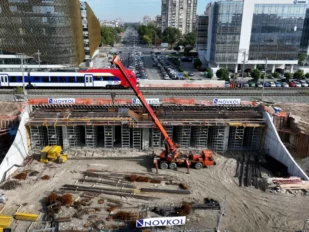
The late joining of Grecia and Surčinska streets, the construction of an underpass between Red Army Boulevard and Art Boulevard, the expansion of Patriarch Pavle Boulevard and many other infrastructure works

Payment of money starts on Friday, November 13, and scheduling is made possible through the website of Poštanska Štedionica

The student movement asks the competent state institutions to examine public procurement, the implementation of contracts, the spending of budget money and the respect of workers' rights in the construction sector.

At the moment when the institutions of the Republic are destroyed, when Vučić's octopus is still alive, when people are disgusted by the injustice and the stench left behind by the Essenes regime, we have, as Machiavelli said, only civic virtue as the fuel with which we can return to the beginning

The four independent members of REM are an example of perseverance and civic responsibility. Rodoljub Šabić even, upon leaving the premises of REM, after the sentencing of the Informer, experienced that the Essenes insulted him, hit him with their hands and feet. But that too will soon be over

Vučić pardoned the batterers and Dijana Hrkalović. The election winners should abolish the sultan's power that allows one man to run afoul of the entire judicial system

Interview: Branko Stamenković, public prosecutor of the Supreme Public Prosecutor's Office
A black picture and the breakdown of the rule of law subscribeThe archive of the weekly Vreme includes all our digital editions, since the very beginning of our work. All issues can be downloaded in PDF format, by purchasing the digital edition, or you can read all available texts from the selected issue.
See all



