Chronicle
Terrorist attack in front of the Embassy of Israel in Belgrade: One attacker killed
One person was killed when he attacked a member of the Gendarmerie with two knives in front of the Israeli embassy in Belgrade

Children in Serbia are often victims of legal and financial injustice - while court cases continue, many parents do not fulfill their obligations, and children are left without the necessary financial support. What problems do parents and children have with alimony and what is planned to make the situation better
Sara Stanojković was 10 years old when she met her father. In court.
"Until 2011, I wasn't in contact with my father. We didn't even know each other. My parents split up before I was born. I was in the fifth grade when I wanted to meet my father. The only way it could happen was through the judicial system," Sara told "Vreme".
"He then asked to establish paternity through DNA analysis," he continues. "After that, after proving paternity, we hoped that things would be resolved," says Sara.
However, things only started to get complicated then. What she hoped for, that she would see her father, did not happen, since he refused that legal right.
In the meantime, over the past 14 years, Sarah and her mother have initiated numerous legal proceedings against their father, some of which are still awaiting final decisions.
In one of the proceedings, it was determined that Sarah's father was obliged to pay alimony. However, these payments were not regular.
Her father would come to the trials with various payment slips, and since there were different fees for different procedures, an expert was hired to determine what was paid.
Sara is not a unique case of a child to whom the parent who does not get custody after the divorce does not regularly pay alimony.
Almost half of the fathers (44,5 percent) who, after the divorce, have been ordered by the court to pay alimony, do not pay that amount, according to the research of the Center for Mothers "Financial independence of mothers in Serbia: The right to your dinar".
Of those who pay alimony, a large number of them (46,2 percent) do not do so regularly or have even reduced their income in order to make the court-ordered alimony less. Thus, almost 85 percent of children after the divorce of their parents from their fathers do not receive regular education alimony.
View this post on Instagram
When inflation eats up alimony
And when alimony arrives, in half of the cases it does not even cover half of the child's expenses.
When she got divorced five years ago, the then 23-year-old "Vremena" interviewee, who wishes to remain anonymous, but her name is known to the editorial staff, started receiving 10.000 dinars a month in child support from her ex-husband.
Since they divorced by mutual consent at the first hearing, her lawyer even suggested an amount several thousand less.
"I was quite young, I didn't know much and I trusted the lawyer. It's just that I didn't even inform myself, I thought, I'm paying a lawyer, he knows the law and how it works. I agreed for 10.000 dinars. I had no idea that I had the right to the exact amount of his salary," says this now 29-year-old mother of the champion student.
Meanwhile, inflation has risen, the cost of living is higher, but she and her child receive the same agreed-upon amount from their father.
Admittedly, they get it regularly, but she was thinking of suing her ex-husband again on this matter. She always gave up because it was important for her to have her own peace.
The amount she receives covers half of the cost of the kindergarten, and the other 5.000 dinars per month remains for her to support the child.
"He simply considered that, given that I asked for a divorce, I should bear the consequences. Now, when he buys something from the wardrobe for the child, he does not allow that wardrobe to be brought home, but stays with him," says the "Vremena" interviewee.
How is alimony determined?
When it comes to determining the amount of alimony for a child, there are two basic ways of determining its amount during a divorce. The first is consensual - when the parents agree on the amount of maintenance, which must be approved by the court. Another way is for the court to independently decide on the amount of alimony, taking into account all the circumstances, which is usually the case in divorce proceedings.
The amount of alimony that one parent will pay is determined based on his income, and the amount is also affected by the child's expenses. Additional expenses of the parent - the provider of alimony, such as supporting another person, medical expenses, are taken into account.
The minimum amount of alimony for a child is equal to the amount of compensation provided for minors (or half of this amount when alimony is paid by one parent). The amount of compensation for foster carers is regularly determined by the ministry in charge of social affairs.
The prescribed amount of compensation for minors is adjusted regularly, and in April 2025 it amounted to RSD 50.974. When this amount is divided between two parents, the recommended minimum alimony amount for April 2025 is about 25.000 dinars.
Although the Republic of Serbia has a certain amount of the minimum amount of alimony, which it adjusts to the increase in compensation for minors, as many as 91,3 percent of fathers in Serbia do not respect it, according to the research of the Center for Mothers.
Fathers' attitude towards alimony is statistically related to the time they spend with their children.
Fathers who do not fulfill their financial responsibilities, and if they do, they do not do so regularly and do not follow the inflation rate, spend less time with their children, thus 25,8 percent of fathers in Serbia do not see their children, and more than a third of fathers spend less than a quarter of their independent time with their children, research shows.
Sometimes even a lawsuit isn't enough.
In 2009, Milica got divorced in XNUMX, with a stomach "up to the teeth", in the seventh month of pregnancy.
She left the house where she lived until then with her six-year-old son.
Six months later, at the hearing, the court ordered the father of their two children to pay alimony of a total of 16.000 dinars.
Milica says that her ex-husband then declared in court that he was ready to give more than that and agreed to a higher amount.
However, he paid only the first amount. In the meantime, he gave various excuses as to why he could not pay alimony, and a few years later Milica sued him.
According to the laws in Serbia, she could only sue him for the money he owed her in the last three years.
Her ex-husband had to pay her two alimony payments per month for the next three years, in order to pay off the debt of 720.000 dinars, the court decided.
In court, Milica offered to determine the pace of debt repayment herself.
After the trial, her ex-husband paid her three alimony payments. Then he stopped making payments. It was eight years ago.
"He promised to pay every time I called, but that money would never go to the account," she tells "Vreme".
She talked to lawyers, who suggested numerous possibilities to collect this money, but she did not initiate any further proceedings, because she did not want to enter into further conflicts.
Sixteen years later, when he meets the children, the father gives them 1,200 dinars each, but he still does not pay alimony, says Milica. The older son is of age, so he has no right to her anymore, but the younger one is now in the first grade of high school.
New hope - alimony fund
Before the members of the Parliament of Serbia is the Bill on the Establishment of Rights from the Alimony Fund, which should solve the problem and force unscrupulous parents to settle their obligations.
The alimony fund is a protection mechanism that provides support for the child when the parent who is obliged to do so does not pay alimony, according to the proposed law.
The alimony fund would represent a fund from which children whose parent - even though he is obliged to do so by an executive document, i.e. a final and enforceable court judgment - would not pay maintenance to the child for at least two consecutive months.
The right to temporary support would last until the age of 18, that is, until the parent begins to fully fulfill the obligation of support.
By the way, the existence of such a fund has already been introduced into Croatian and Montenegrin legislation, while for the domestic legal system, the introduction of an alimony fund would be a novelty.
Avoidance of alimony payments
According to the data of the Republic Institute of Statistics, more than 9.000 marriages are divorced in Serbia every year, of which more than 5.000 involve children.
According to some estimates, only a third of divorced fathers, or three-quarters of mothers, regularly pay monthly allowances.
Failure to pay maintenance is a criminal offense punishable by a fine or up to three years in prison. However, practice shows that such procedures often take a long time, and maintenance debtors use various methods to avoid the obligation - they hide property, real estate, resign, so that the executors could not carry out the confiscation. The debts are up to one million dinars, RTS wrote earlier.
Imprisonment is rarely used. For example, in 2021, 1.795 criminal charges were filed for non-payment of alimony, and 123 people ended up in prison.
However, a prison sentence cannot provide financial support to a child at a time when it is needed. This is how the idea of the Alimony Fund was born, from where child support would be paid instead of the parent who does not respect his legal and judicial obligation, and this fund would then be refunded from the parent who was obliged to fulfill the obligation to provide support, but did not do so.
One person was killed when he attacked a member of the Gendarmerie with two knives in front of the Israeli embassy in Belgrade

The Gymnasium in Čačak announced that the Ministry of Education is expected to accept Katarina Majstorović's resignation without delay and to appoint teacher Irena Simović as acting director.

Two television stations close to the outgoing authorities today told all employees to stay at home - allegedly for fear of threats, "Vremen" confirmed.

Citizens broke into the newsroom and interrupted the Informer television program, and threw eggs at the Pinka building. The police intervened at both locations, but "delayed" at Informer. These actions have nothing to do with the Student List and the Student Movement, which have expressly declared against any street justice.

Everything that happened on RTS in the last two years did not happen because of a "handful of čats and loyalists", stated a group of employees at that media.

The citizens of Serbia have pronounced a political verdict. Violence, persecution, abuses, embezzled money must be decided by freed institutions based on the law
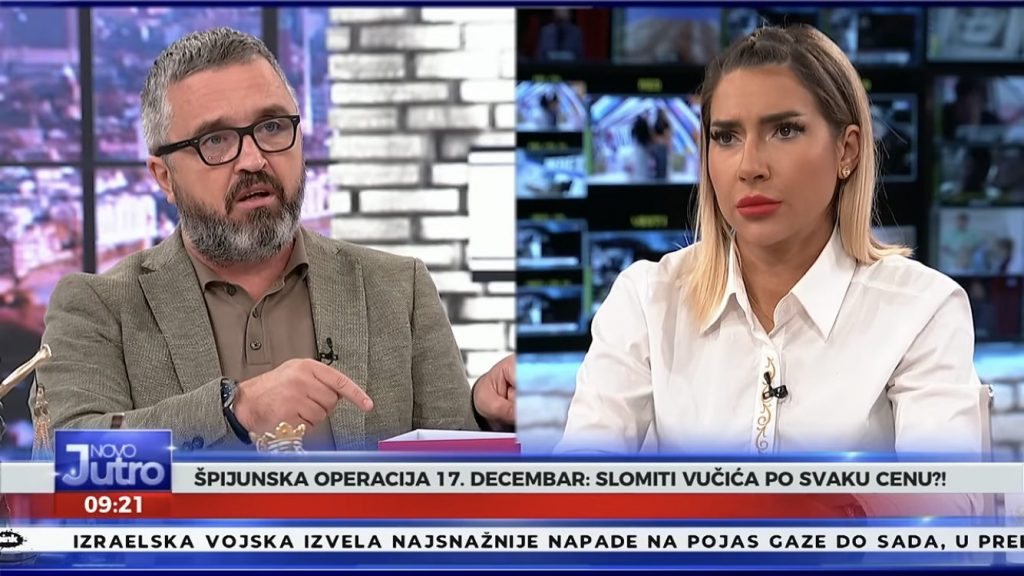
Requiem for evil does not have to be solemn. Sometimes it sounds like a shaky voice on a morning program and like a story about winter tires.

It is necessary, first of all, to somehow get to the act of handing over power, if there is anyone from the Essenes who would hand over power. We want to say: Vučić and his team must not be trusted for even two seconds until the government is constituted

The archive of the weekly Vreme includes all our digital editions, since the very beginning of our work. All issues can be downloaded in PDF format, by purchasing the digital edition, or you can read all available texts from the selected issue.
See all