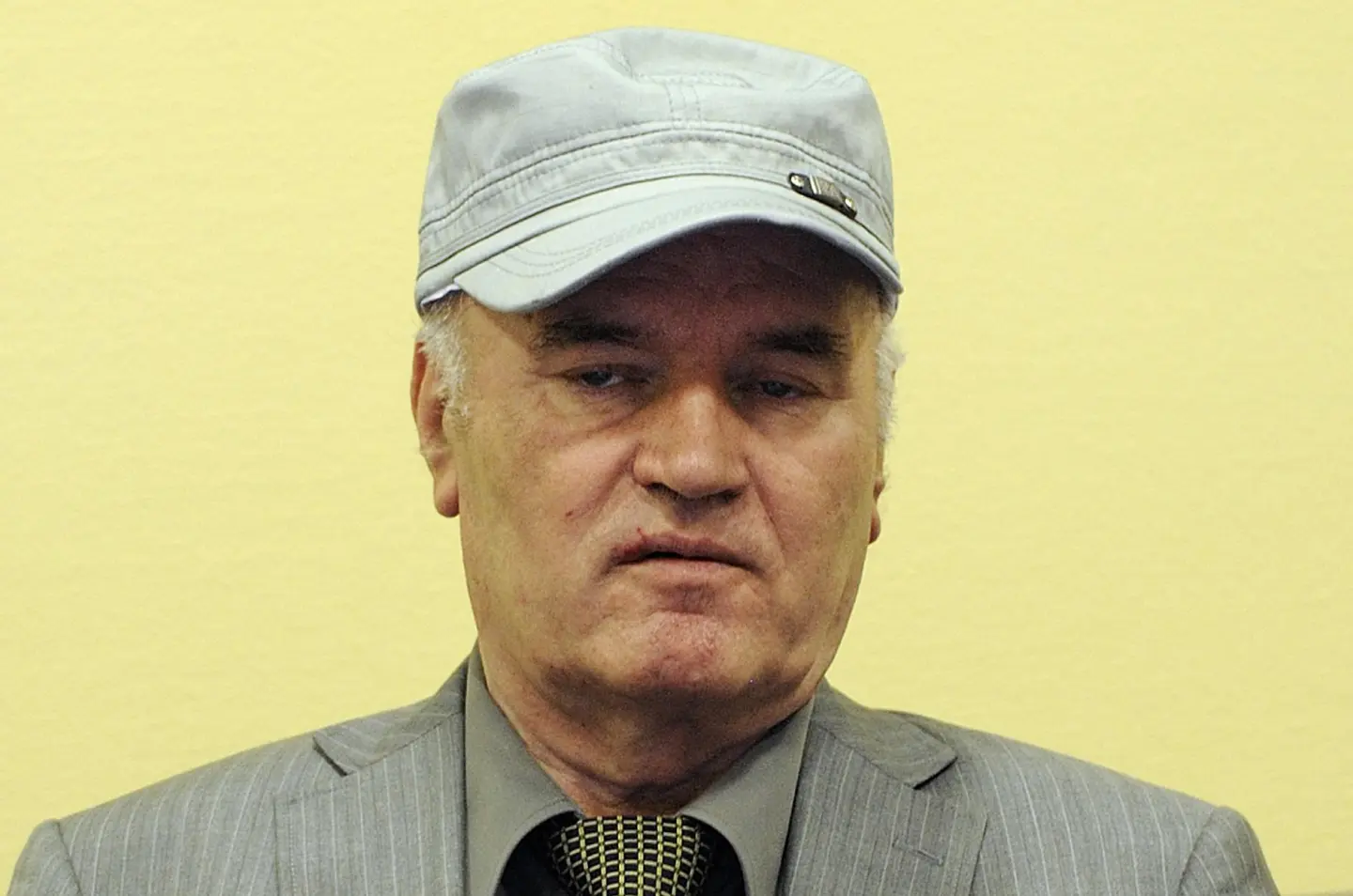
What prompted the commander of the Army of the Republika Srpska, after three decades of professional service, to trample not only the officer's honor but also everything human in him, and set off on a journey that will end in the detention unit in Scheveningen
The former commander of the Main Staff of the Army of the Republika Srpska (VRS) and the man who is in charge The Hague Tribunal finally convicted of genocide over the Bosnian Muslims in Srebrenica, he died in prison.
About how the colonel of the Yugoslav People's Army became a general of the VRS and a war criminal was once written by "Vremena" journalist Dejan Anastasijević.
Exploring what drove Ratko Mladić that after three decades of professional service he tramples not only the officer's honor but also everything human in himself, and sets out on a path that will end in the detention unit in Scheveningen, Anastasijevic first referred to a story from the time when Mladić was still a "young colonel", the commander of the Knin garrison of the JNA.
The story of Ustashas and Chetniks
That story says, Anastasijević wrote, that in the second half of 1991, at the beginning of the war in Krajina, Mladić noticed a group of soldiers who had torn off red stars from their caps and replaced them with Chetnik cockades.
Mladić then allegedly lined up those soldiers, reached into his pocket and took out a handful of Croatian military insignia, including several letters "U". "I took this off the dead Ustasha," Mladić told them at the time, "and whoever I see wearing the cockade will go the same way as those Ustasha."
Not even a few months passed, and Mladić became a general, so he replaced the general and the officer's cap with a copy of Duke Mišić's cap, and the pentacle with the cockade of the Republika Srpska. A few years later, Mladić entered history in big red letters as the organizer of the most terrible crime committed in Europe after the Second World War.
Photo: AP Photo/Radivoje PavicicRatko Mladić with the Russian delegation in Banja Luka, October 1995.
In his text, Anastasijević points out that this is not a metaphor, because on the military map from the headquarters of the RS Army, which the media published on several occasions, the area around Srebrenica was circled with a red marker. Next to the edge of the circle, in Mladić's large, almost childlike handwriting, he writes: "This was and is now." Serbian". In order to remove any trace of doubt, Mladić signed and dated this sentence: July 12, 1995.
"He was, without a doubt, convinced that one day that signed map would hang in Belgrade's Military Museum. Instead, it was included in the evidence of the International Criminal Tribunal for the former Yugoslavia, and after the trial it will probably become a museum exhibit, but in one of the few existing genocide museums," wrote Anastasijević.
Product of the JNA
In the text "How Ratko Mladić gave himself up to genocide", Anastasijević deals with this very phenomenon as the main topic: how a professional officer who, based on everything known about him, never showed an iota of nationalism before the war, turned into a heartless executioner in a short time.
"When one walks through the gallery of world (and local) villains, one can almost always recognize a motive, which is usually, as Hannah Arendt showed on Eichmann's example, usually banal. Careerism, tyranny, greed, and even the most ordinary cowardice can turn ordinary people into monsters in stormy times, when they get involved in some kind of historical enterprise. Mladić, however, does not fall into any of the listed categories: he was, admittedly, extremely ambitious in his profession, but he could not be attributed to Bonapartism; although he was often in a fight with Radovan Karadžić, it did not occur to him to simply declare himself the Leader; he did not believe in anything fanatically, nor was he a coward," wrote Anastasijević.
Photo: AP Photo/Radivoje PavicicRatko Mladic, 1995.
Anastasijević pointed out that it is impossible to give a simple answer to the question of what prompted Mladić to trample not only on the officer's honor but also on everything human in him.
It seemed to him that at least one part was hidden in Mladić's pre-war biography.
"He was, almost literally, a product of the JNA, more precisely of its General Staff in Belgrade, and leaving morals aside, one could say its best product. Joining the army at the age of fourteen, as a student of the Military Industrial School in Zemun, he entered an institution that, within the then system, was a world unto itself, completely separate from the rest of society, which was often pejoratively called 'civilianism'. Within that system, he remained until his retirement, when The Hague indictment forced him to go underground, but even then, based on what is known, he was mostly hanging around military facilities and in military apartments. With the exception of his family, he had no contact with civilians, except for the most necessary ones; he probably considered them a kind of necessary evil, which existed to provide the army with necessary supplies. He was, of course, a member of the Communist League, and declared himself a Yugoslav. wrote Anastasijevic.
Photo: AP Photo/Darko VojinovicDespite everything, Ratko Mladić is still considered by many Serbs to be a Serbian hero
A chance to beat real enemies
The young man hated office and staff work and felt best on the field, among the army, and he often took his children with him to exercises and marches. And during the war, it was easier to find him in the trenches than in the command in Han Pijesk - which brought him great popularity among the soldiers.
"Had it not been for the war, Mladić would undoubtedly have been promoted to general near the end of his career and as such would have received his retirement. But, when the country he swore to serve began to burst at the seams, Mladić found himself in the very center of the whirlwind, in Knin, only to be reassigned to Bosnia immediately after the implementation of the Vance Plan. That's where his transformation really began: Yugoslavia fell apart, but one thing remained: the JNA, which, in truth, changed its name, symbols, ideology and ethnic structure, but it remained almost untouched. Civilian life disappeared like a lump in the sun, and the army, in which Mladić was on his own, became his own, at least where he was. He was given the opportunity to start using the skills acquired during training and to fight real enemies instead of imaginary ones. History gave him an offer that he could not refuse.
Photo: AP Photo/Radivoje PavicicRatko Mladić and Radovan Karađić in Banja Luka in 1994
He also emphasized that Mladić, "for the sake of order, for the needs of the service", accepted Tito's version of communism, so, at least in the beginning, he "adopted Serbian nationalism almost reluctantly: it was required of him so that he could do what he only loved to do - to fight".
"It conveniently happened that the enemies - first the Croatian Army, and then the BiH Army - were poorly organized and even less armed, and if, as in Bosnia, it was difficult to distinguish soldiers from civilians, so much the worse for civilians. He had a distinct gift for public appearances, during which he successfully presented himself, as Karadzic would say, as an 'officer.' to the battered, undisciplined staff of the Army of Bosnia and Herzegovina, Mladić acted as an example of professionalism. Many were inclined to ignore that this professionalism was aimed at destroying human lives," wrote Anastasijević.
Photo: Jerry Lampen/Pool via APRatko Mladić in the courtroom of the Hague Tribunal
Mladić's last moral scruple
He also stated that "the last trace of something that could be called moral scruples was manifested by Mladić on May 12, 1992, at a closed session of the RS Assembly."
At that meeting, Karadžić and Momčilo Krajišnik presented the war objectives: demarcation of the Serbian people from other peoples, along with the seizure of more than 80 percent of the territory of Bosnia and Herzegovina, including half of Sarajevo. The young man then said:
"People and nations are not chickens or keys in your pocket, so we will move them here and there." ... We cannot wage war on every front or against the people, I would suggest here that we adopt such a mindset that we will not go to war, and if we are attacked we will defend ourselves and we will not go to war against the Muslims as a people, nor against the Croats as a people , but against those who led that people and incited them against us... Therefore, we cannot clean nor can we have a sieve to sift only that the Serbs remain or that the Serbs fail and the others leave. Well, that's it, that won't happen, I don't know how Mr. Krajisnik and Mr. Karadzic will explain to the world. That, people, is genocide."
Photo: AP Photo/Peter DejongRatko Madić at the Hague Tribunal in 2017.
"Messrs Karadžić and Krajišnik knew this even without Mladić, but this moment represented Mladić's personal Rubicon: it was the hour in which he could decide to refuse to participate in that monstrous undertaking, which would have caused him to fall out of favor with his bosses in Belgrade in the worst case, but he would have retired with a clear conscience. Unfortunately for tens of thousands of dead and hundreds of thousands of displaced people, he chose to get to work on his own. Srebrenica was only logical the end of the path he consciously set out on," Anastasijević concluded.
Only in August: Save three thousand dinars on the annual subscription to the digital edition of "Vremena"!Take advantage of the discount hereand support independent journalism.
What is happening in the country and the world, what is in the newspapers and how to pass the time?
Every Wednesday at noon In between arrives by email. It's a pretty solid newsletter, so sign up!
Since the election results were announced, Aca Lukas, Jovana Jeremić and their other colleagues from the variety show, known as big supporters of Vučić, claim that they are looking forward to the victory of the Student List.
The VJT in Belgrade considers it justified that the two defendants in the case of the death of pensioner Stanimir B. in custody in Padinska Skela were sentenced to effective prison terms, but is not satisfied with their length
By abandoning the introduction of new bus lines that would connect Belgrade with the Expo complex, the city budget was spared the cost of around 80.000 euros, says CLS director Nikola Jovanović.
Serbia in the winter period with limited possibilities of domestic electricity production, because thermal power plants, as the basis of the electric power system, have problems due to the poor quality of coal, while hydro storages are at a low level
Thanks to the negotiations with the European Commission, Serbia should become part of the European system "roaming like at home", which would allow mobile phone users to make phone calls, send SMS messages and use the Internet without additional roaming costs when traveling between the EU and the region.
The four independent members of REM are an example of perseverance and civic responsibility. Rodoljub Šabić even, upon leaving the premises of REM, after the sentencing of the Informer, experienced that the Essenes insulted him, hit him with their hands and feet. But that too will soon be over
Vučić pardoned the batterers and Dijana Hrkalović. The election winners should abolish the sultan's power that allows one man to run afoul of the entire judicial system
Davor Matura's ALTA empire is the transplanted heart of the corrupt regime of Aleksandar Vučić, who was defeated in the October 25 elections. From ALTA Bank, roads lead directly to the top of the progressive government.
The archive of the weekly Vreme includes all our digital editions, since the very beginning of our work. All issues can be downloaded in PDF format, by purchasing the digital edition, or you can read all available texts from the selected issue.