

Society
On the night between Saturday and Sunday, winter time starts
The hands of the clocks will be moved back one hour, so the time will be calculated as if it were two hours after midnight at that moment.

The re-introduction of compulsory military service in Serbia caused numerous doubts among military analysts. Deutsche Welle's interlocutors claim that this is a propaganda move - because the professional team has dispersed due to poor conditions, low salaries and political games.
Almost exactly 14 years ago, the then President of the Assembly Slavica Đukić-Dejanović proudly declared: "Out of 135 deputies, 133 voted for the proposal, so I state that the National Assembly adopted the proposal for a decision on the suspension of the obligation to serve military service".
In December 2010, in Serbia, military service was abolished for all those who do not want to be soldiers, and it was introduced professional army which will be "more motivated", as it was announced at the time, it says Deutsche says.
But, that "more motivated" army has largely run away from work to this day. In the last five years, 13.000 professionals have left the army - mostly because of poor conditions, low wages and political games, critics say.
The decision on the return of mandatory military service was signed these days. The decision was signed by the President of the country, Aleksandar Vučić.
The Government of Serbia adopted the decision and instructed the Ministry of Defense to initiate the procedure before the Parliament.
There is no doubt that Ana Brnabić, from the position of the President of the Assembly, will proudly announce that the mandatory military service of 75 days has been adopted by the majority of votes.
Citizens mostly for the introduction of military service
"If it's like in Israel or Switzerland, where there is no excuse for anyone, two years for everyone - that's one thing. And this makes no sense. "What can be learned in 75 days, and who can become a soldier in 75 days," asks a middle-aged Nisli.
Another believes that those 75 days are also useful: "It's a good boost for young people to wake them up and bring them back to the reality of the present."
This man is considered to be in the majority in Serbia. According to available polls, over two-thirds of people support conscription. Even the majority of young people support this.
A few years ago, a survey by the House of Wine agency circulated, according to which 72,5 percent of young people (17 to 30 years old) declared for the mandatory army.
Ali, not everyone is thrilled: "I'm 34 years old and it doesn't bother me, but if I was 25 or more, I wouldn't care," one man tells us. "I'm the generation that didn't go to the army, but I certainly don't agree with the narrative that you only become a man in the army."
Another Nišlija adds that he is bothered by the rhetoric of the state leadership: "All this fuss that we have to defend ourselves from someone is bringing some unrest into a people that is already restless, and making some defensive moves, and no one is attacking us, thank God, nor will they." ".

Populism and adulation
Military commentator Petar Bošković, who spent most of his career in information and public relations affairs of the Ministry of Defense, agrees with the latter.
Military service, he says, is a blurring of the situation with Rio Tinto and with Kosovo. The decision, he believes, exclusively political, not military.
"Because if it was military, the army would have announced itself." You see that no one advertises, you don't have generals, heads of the personnel administration of the Ministry of Defense, or heads of the human resources administration of the General Staff," says Bošković for Deutsche Welle.
Military analyst Aleksandar Radić says that the top of the army "is trying to please Aleksandar Vučić as much as possible and is not interested in what is happening in the defense system."
"They move the existing active army like a big traveling circus from place to place for the purposes of demonstration exercises and various reviews for the promotional needs of the political elite and the party."
Such people are then surprised that it is difficult to get quality personnel for service in the army," says Radić.
That is another reason why the regular deadline is being introduced, points out Petar Bošković. "They don't want to admit that they ruined the army." Because if they had not ruined it, 13.000 people would not have left the army. So, they decimated the army, and simply because of that, the training and ability of the army to react also fell."
A thousand and one questions
Numerous problems have accumulated in the last 14 years, says the interlocutor of Deutsche Welle, criticizing ad hoc solutions instead of long-term ones.
He recalls that, when Serbia switched to a professional army, five thousand boys and girls were chosen annually to voluntarily serve as conscripts. The idea was that part of them would be attracted to the army and stay there professionally.
"But it was not used because after a month of stay in the barracks and training centers, those boys and girls saw how officers and non-commissioned officers live, how in fact - they don't live," says Bošković.
He cites a number of concerns that produce "complete chaos." Let's say, what about gender equality when girls are not called up for mandatory military service, but apply for military gymnasium and academy?
Furthermore, will voluntary military service for girls remain for six months, while the mandatory one is now only 75 days? What about conscientious objection?
"You can't take away someone's once-acquired right." And let me remind you, when we switched to a professional army, more than 60 percent of the recruits made a conscientious objection and did not want to serve in the army under arms," says Bošković.
When asked what will happen to national minorities such as the Albanians in the south of Serbia, or to the residents of Kosovo, which, according to the Serbian Constitution, are counted as part of the state's territory, Bošković says:
"You don't think that the residents of Preševo, Bujanovac and Medveđa will serve in the army for 75 days, do you?" It will be the same as when we introduced the professional army, simply silently the recruiting centers didn't even call them. And you can't count on Kosovo after the Ohrid Agreement", he believes.

Just basic training in 75 days
There are about 300.000 young men between the ages of 18 and 29 in Serbia, but not enough barracks and only eleven training centers. According to military analyst Aleksandar Radić, only three military training centers are currently operating, and the training providers are "too old".
This means that a generation of training providers will first have to be produced in order for the training to begin.
"If compulsory military service is resorted to, it would make sense to introduce a period of at least six months, if not nine months." During that time, complete and meaningful individual and collective training can be carried out and part of the period can be spent in one of the active battalions," says Radić.
"The deadline of 75 days is to satisfy the form - some training will be carried out and reservists will be obtained," he believes.
Radić also says that Serbia is the only country that keeps the number of the army a secret, while all countries in the region publish this information. "Everything starts from that problem - concealment leads to lying and pressure on people who then leave the service."
He reminds that this year, the first man of the Military Union of Serbia, Novica Antić, who was held in custody for almost six months, was in the news. According to Radić, the reason is that Antic "boldly" talked about the soldiers leaving and the barracks being half empty.
And now, he says, the trade union has been silenced, which has demoralized the professional army even more.
How much will everything cost?
When asked how much a professional army costs Serbia annually, and how much mandatory military service will cost Serbia, Radić says:
"It is too early to talk about the price, but it can be done, there is money. "Recently, a contract of 2,7 billion euros was signed just for twelve Rafal planes, and more money will go to arming those planes, which is the same amount as the cost of the entire army for almost three years, from salaries to exercises and new weapons," says Radić.
Therefore, money will not be a problem, he believes. "It should be borne in mind that the money for the soldiers remains in Serbia in the domestic economy."
Petar Bošković explains that the annual budget of the army is 1,4 billion euros, and that during the time of Minister Zoran Đorđević, a rough estimate was published that the introduction of military service would cost an additional 800 million euros.
Bošković, as an officer, has no principled objections to the spending of money on weapons, but he has objections to this type of procurement. "It's not normal that you buy an air defense system from the Chinese, and you have French Rafales, and then you have German helicopters, Russian artillery or combat vehicles."
He says, it is bought politically, for the sake of "staying in power". And there it comes back to the first problem, which even the regular term will not solve: "Who will manage those systems if you don't have people?" 250 tanks are useless when you have 50 crews," concludes Bošković.
The hands of the clocks will be moved back one hour, so the time will be calculated as if it were two hours after midnight at that moment.

As of August of this year, some pellet factories have already reached the quantities produced during the entire year 2025.

At the same time, the participants of the walk were three times more represented among RTS interlocutors

PIO Fund has warned pensioners about new fraud attempts to sign declarations about the purchase of certain products, for which the monetary compensation is suspended from their pension
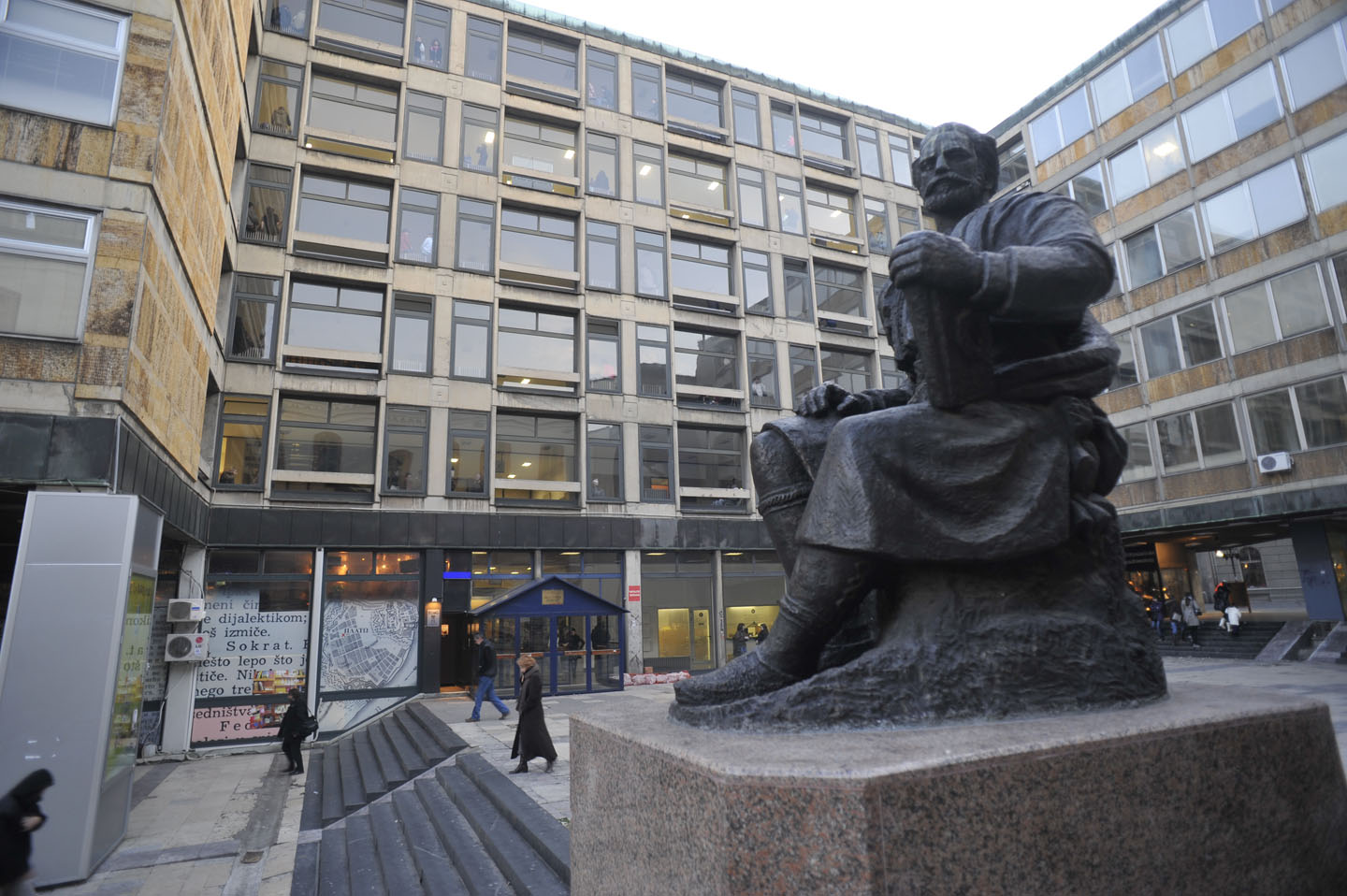
After numerous problems and the transfer of responsibilities, a permit was issued for the reconstruction of the Academic Plateau at the Faculty of Philosophy in Belgrade

There is, literally, no difference between the one who claims it is day in the middle of the night, or the one who claims to be a giraffe, from the claims we read on billboards: that Vučić is working to unify Serbs and that Serbia is doing better and better day by day.

The pre-election arrests due to the alleged "overthrow of the state" testify to the regime's panic. The bad news for them is - they can't arrest the whole people who decided to defend themselves from progressive beatings and election theft

The ring that tightens around Ćaciland Student list is getting narrower. Because there are more and more spoiled people who see the false prophet for what he is: a street obscener who is fighting Serbia

The archive of the weekly Vreme includes all our digital editions, since the very beginning of our work. All issues can be downloaded in PDF format, by purchasing the digital edition, or you can read all available texts from the selected issue.
See all




