Introduction
"When earthquakes happen in the world, they are talked about a lot. While they last, every little thing is recorded. Human victims and the names of the victims are also recorded. And it is known how many houses were destroyed on that occasion. After a few years, however, the number of human victims is forgotten, then exaggerated, invented, and only the places where there were earthquakes are remembered.
So it is with volcanoes and floods.
While volcanoes are burning, there is countless news and information about them.
And when the volcanoes go out, no one talks about them anymore, and if they do, they make things up.
It's the same with papers from the past, which talk about fires, plagues, wars, and even migrations."
Like this in the end Other books Migration writes Miloš Crnjanski, who dedicated his most important works to the fate of refugees and the curse of the fate of "migrants", as it is popularly said today, whether it is the migration of Serbs to Russia in the 18th century or the fate of Russian refugees to England after the October Revolution.

Today we are witnessing large migrations of peoples. The statistics that follow modern migrations say nothing about the fates and misfortunes of individual people whose lives have been fundamentally changed by them. This year, more than half a million people from Syria, Afghanistan, Iraq, Somalia, Eritrea, Pakistan... who, fleeing wars, are trying to reach "Fortress Europe" believing that a peaceful life and safety await them there. The "Western Balkan migrant route" is only one of eight sea and land routes through which the rivers of migrants from Asia and Africa flow towards Europe. Refugees from the broken countries of North and Sub-Saharan Africa reach Europe via the Mediterranean Sea, and news about the number of refugee victims from ships and boats sunk in the Mediterranean is increasingly inconspicuous in the media. The United Nations cites the humanitarian crisis caused by wars in 37 countries, which affects 78,9 million people, as the reason for the current migration. Hundreds of thousands of people are already on the move, millions are preparing to travel. From Syria alone, more than four million people live in refugee camps in Turkey, Lebanon, Jordan, while more than eight million are displaced within the country - in total, almost half of Syria's approximately 25 million inhabitants. There are no indications that these migrations will stop soon, and the numbers that speak of the scale of the migrant wave today are so great that it is being called a new great migration of peoples, similar to the migrations of the past that dramatically changed the image of the world. Throughout history, the Balkans and Serbia have often been an area where large population migrations took place, either as a transit area, or as a place where peoples arrived to stay, or as an area from which people left in migrations. Especially the area of Vojvodina remained marked by large migrations.
By pointing out the fact that migrations do not only happen to others, and with the aim of eradicating stereotypes and prejudices about today's migrants, here we will briefly remind you how migrations took place throughout history in the area of Vojvodina and how they permanently determined its today's multi-ethnic and multi-confessional a mosaic made up of 26 national minorities. Most of the inhabitants of Vojvodina, regardless of their nationality, origin, are migrants, refugees or colonists, it's just a question of which generation of "arrivals" they are.
Vojvodina has been an area of large migrations since ancient times. Every periodic wave of migration throughout history, and they went in all directions - from east to west, and from west to east, and from north to south, and from south to north - changed the face of Vojvodina
ANCIENT MIGRATION: The oldest traces of human settlements on the land of today's Vojvodina, found in Petrovaradin and in the vicinity of Vršac, come from the Old Stone Age. The Neolithic culture in the central Balkans, which developed during the 5th millennium BC, is called the Starčevo culture after its site in the Banat town of Starčevo. The migration of people from the direction of Anatolia will result in the establishment of a new cultural matrix, which we call Vinča. Traces of Vinča culture are also found in Vojvodina, in Gomolava, Vrdnik, Obrež, Aradac, Botoš and elsewhere. After a thousand-year existence in these areas, the powerful Vinča culture disappeared, for reasons that have not been fully explained scientifically, but could be related to the migration movement at the end of the Neolithic era. Several subsequent waves of great migrations of peoples, which will begin at the end of the XNUMXth and the beginning of the XNUMXrd millennium BC, from the Asian steppes and from the area of South Russia and Ukraine through the Danube to the south, will create new civilizational conglomerates. During the Copper Age, the complex of newly arrived cultures spread their influence on Vojvodina along the Tisza River; traces of settlements from the Iron Age found in localities such as Gradina na Bosut, Kalakača and Židovar near Vršac speak of an extraordinary cultural mix in this area.
The peoples who inhabited the area of Vojvodina in the last millennium of the old era are of Illyrian, Thracian or Sarmatian origin. The Illyrian tribes Pannon, Amantini, Breuci and others inhabit Srem and Bačka, and the Thracian Agatirzi, Geti and Dacians - Banat. At the beginning of the third century BC, the great Celtic migration from central Europe to Greece and Asia Minor begins, and the Celtic tribes Skordisci, Boji and Eravisci arrive in Vojvodina. Sarmatian Jazigis arrive in Bačka from the opposite direction. In the 1st century, the Romans arrived on the banks of the Danube.
With the arrival of the Romans on the banks of the Danube, the written history of this area begins. The Romans occupied Srem in the 1st century, consolidating their power by crushing the great Illyrian uprising. After the victory over the Dacians in the 2nd century, they also conquered the Banat. During the 1st century, the Danube became the northeastern border of the Roman Empire. In order to protect this border from incursions and migration of peoples from the East, the Romans built a system of fortifications, military camps, ramparts, observation posts and roads on the Danube that make up the so-called Danube limes. The most important Roman city on the territory of Vojvodina became Sirmium (Sremska Mitrovica), which was one of the capitals of the Roman Empire during the Tetrarchy. Six Roman emperors from the 3rd and 4th centuries were born in Sirmium, or near it - Dacia Trajan, Aurelian, Probus, Maximian, Constantius II and Gratian. It is assumed that they were originally Romanized Illyrians.
MIGRATION OF PEOPLES: In the middle of the 518rd century, nomadic tribes from the east and north came to the Danube in waves. Among them are the Germanic Goths who settled in Banat. From the 527th century, the Huns penetrated into Pannonia in a campaign of conquest. They are suppressed by the Germanic Gepids. In the UV century, Byzantium took over the administration of Srem. During the reign of the Byzantine Emperor Justin I (1000–XNUMX), the first arrival of Slavs to the Pannonian Plain and the Balkans was recorded. In the middle of the XNUMXth century, the Avars arrived from the Asian steppes, who, with the help of the Slavs, took over Sirmium and Singidunum from the Gepids and created their own state on the territory of Vojvodina. At the beginning of the XNUMXth century, among the numerous Slavic peoples who inhabited Pannonia and the Balkans, the Serbs arrived. At the end of the XNUMXth century, the Franks conquered the Avar state. In the XNUMXth century, the warrior tribe of Magyars arrived in the Pannonian Plain. By the XNUMXth century, they conquered the entire area of today's Vojvodina. In XNUMX, Hungary became a kingdom. During the Middle Ages, the population of Hungary was mixed and made up of Hungarians, Serbs, Croats, Cumans, Saxons, Szeklers, Vlachs and others. During the Hungarian administration, the territory of Vojvodina experienced the reconstruction of city dwellings and economic progress. A larger number of Serbs began to settle in the area of Vojvodina from the XNUMXth century. After the Turkish conquest of Serbia, from the middle of the XNUMXth to the first decades of the XNUMXth century, Serbian despots as Hungarian vassals ruled parts of Vojvodina with their headquarters in Kupinovo. And then the Turks came to Vojvodina.
TURKISH AUTHORITY: Until the middle of the 1552th century, the entire territory of Vojvodina fell under Ottoman rule, first Srem, then Bačka, and finally Banat. Banat was conquered by Mehmed Pasha Sokolović, whose army included a significant number of Serbs. On the eve of the Banat campaign, in XNUMX, Mehmed Pasha issued a proclamation to the Serbs in the Banat, written in Cyrillic in the Serbian language, in which he promised the Serbs privileges and protection of property and life if they joined the Turks.
The Turks will rule Vojvodina for the next century and a half. In that period, the Ottoman Empire included, among others, today's Syria, Iraq, Libya, Algeria, Sudan, Eritrea, countries from which migrants arrive in Europe today via Vojvodina.
The establishment of Turkish rule is again followed by the exodus of the former population of Vojvodina. The Catholic population, including the Hungarians, emigrates, and the cities are inhabited by an ethnically diverse population - Islamized Slavs, Turks, Arabs, Serbs, Greeks, Cincars, Romanians, Jews, Armenians... Serbs and Romanians settle in the deserted villages... Vojvodina's cities then acquire an oriental appearance. . Sombor has five mosques, Sremska Mitrovica as many as 17, and Mehmed Pasha Sokolović Bečkerek (today's Zrenjanin), due to the merits the local Serbs did to him during the conquest of Banat, turned it into his endowment.
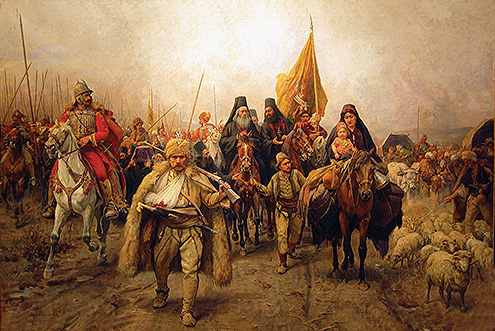
THE GREAT MIGRATION OF SERBS: In 1683, the Turkish army besieged Vienna for the last time, unsuccessfully. At the last moment, the troops of the Polish king Jan Sobieski arrive to help the Austrians, and they defeat the army of Grand Vizier Kara Mustafa. The Turkish army retreats in chaos, and in a great counter-offensive and after a series of successful battles, the Austrian army liberated Hungary in 1689, then Serbia and penetrated all the way to Kosovo and Macedonia. The campaign of the Austrians was supported by a large number of Serbs who started uprisings and joined the Austrian army. But shortly afterwards, the Turks forced the Austrians to retreat to the Danube and the Sava. Fearing revenge for military assistance to the Austrians, the Patriarch of Pec Arsenije III Čarnojević decides on the exodus of the Serbian population from Kosovo and Old Serbia. In 1690, he led a large migration of Serbs to the north. 37.000 families, i.e. about 185.000 people, are going on the journey, and a part of the Albanians is also going on the road to Vojvodina with the Serbs.
After arriving in Belgrade, Arsenije Čarnojević sent a request to the Austrian Emperor Leopold I to allow the refugees to settle in Hungary. The Austrian emperor then issues a charter allowing Serbs to settle as far as Buda and Comoran and guaranteeing them church and school autonomy on the condition that they become Austrian soldiers. This charter legalized the position of Serbs in Hungary.
With the Peace of Karlovac from 1699, Austria formally took over power in Vojvodina, with the exception of the Banat, which in 1718 fell under the rule of the Habsburgs. After the Austrian conquest of Vojvodina, almost the entire Muslim population moved out of these areas. The figures are not known, but it is known that the Muslim population made up the majority of the urban population in Sombor, Mitrovica, Varadin (Petrovaradin), Vršac, Ilok, Titel and elsewhere. A number of Muslim refugees settled in Bosnia and Herzegovina, where they were called "Unđurovci". Upon their arrival, the Austrians destroyed all traces of the Turkish era and Islamic culture.
After the war between the Turks and European Christian countries, including Russia, which is called the Great Turkish, Vienna or Holy League War, at the end of the 17th century, Vojvodina was under the rule of the Austrian Empire, but it was a devastated territory. In order to create a buffer zone towards Turkey, Austria forms a Military Krajina on the territory of Vojvodina, in which the Serbs who arrived with Čarnojević serve as border guards.
Half a century after the Great Migration of the Serbs, in 1737, a new war broke out between Austria and Russia against the Turks who were invading Serbia. And again the Serbs under the Turks, this time at the call of Patriarch Arsenij IV Jovanović, raise an uprising. In a counterattack, the Turks once again expel the Austrians from Serbia, and the Serbs, fearing reprisals, once again set off for Hungary in the second great migratory wave. Vuk Karadžić states that a greater number of these "migrants" from the Second Great Migration of Serbs were killed in Turkish raids than reached Vojvodina, and cites a figure of as many as 80.000 dead. After these migrations, Serbia was almost a deserted country.
PUPIN ON THE SERBS OF VOJVODJA: How important the Great Migration of Serbs was in the consciousness of the Vojvodina Serbs, is evidenced by the words Mihajlo Pupin (1854–1935) wrote in his autobiography From pasture to scholar, for which he received the Pulitzer Prize in America in 1924:
"Even today, when the image of my childhood in the village of Idvor comes before my eyes, I see that the main job of the spiritual life of the village world was to maintain and cherish the old traditions. Knowledge of those traditions was necessary and sufficient for that world to understand its position in the world and in the Austrian Empire. When my people, under Patriarch Čarnojević, moved to Austria and settled in the Military Frontier, they concluded a precisely defined contract with Emperor Leopold I. That contract was recorded in an Austrian state file called 'Privileges'. According to that old contract, the Serbs in the Military Border had the right to spiritual, economic and political self-government. The land that was handed over to them by that contract became their inalienable property. In our village, we supported our own school and our own church, and each village elected its own administration. At the head of the village was a prince, or a headman, usually a shouldered peasant. My father was a prince several times. The bishops and the people elected their spiritual and secular elders, the patriarch and duke, the secular and military chief. We were free, independent owners of the land. For these 'privileges', the people, in turn, took upon themselves the obligation to defend the southern borders against Turkish invasion. But, when our people, under the supreme command of Prince Eugene of Savoy, at the beginning of the 1848th century, helped to expel the Turks across the Danube, and when the emperor discovered the great warrior abilities of the Serbs from the Military Frontier, he encouraged the original provisions of the "Privilege" to be changed so that as if the Serbian border guards had committed themselves to defending the Austrian Empire from all its enemies. Thus, the Serbs from the Military Border defended Empress Maria Theresa from Frederick the Great, they defended Emperor Francis from Napoleon, they defended Emperor Ferdinand from the rebellious Hungarians in 1849 and 1859, and in 1866 and 1866 they defended Austria and Italy. The heroic exploits of the people of Idvor during these wars were the basis for many legends in Idvor, preserved in many stories and ravishing songs. Reading and writing were weak in those days in Idvor, but poetry was in full swing. (..) With 'privileges', the border guards were guaranteed this freedom, and for this freedom they were always ready to fight for the Austrian emperor on all battlefields. Loyalty to the emperor was the basic virtue of the frontiersmen, and that loyalty was even stronger than the admiration they felt for Garibaldi in XNUMX, which is how the Austrian victory at Custoca came about. The Austrian emperor, as the guardian of their freedom, enjoyed a place of honor next to people such as Kraljević Marko, Karađorđe, Emperor Alexander the Liberator, Lincoln and Garibaldi. These names were recorded in the 'Book of Fame' in Idvor.
But, when in 1869 the tsar abolished the Military Border and handed over its people to the Hungarians, the border guards felt that they had been betrayed and that the tsar had broken his word, given to them and written in the 'Privileges'. Even today, I remember how my father told me one day: 'You must not serve the emperor. The emperor broke his word; in the eyes of the border guards, he is a traitor! Border guards despise a man who does not keep his word.' For this reason, there was no picture of the Austrian emperor in my father's house after 1869.
When those days come to mind today, I feel, as I have always felt, that this treacherous act of the Austrian emperor in 1869 was the beginning of the end of the Austrian empire. He was the beginning of the awakening of national consciousness in the empire of Francis Joseph of Habsburg. The people's love for the country in which they lived began to wane, until, finally, it was completely extinguished. And when that love dies, the state must die too. I learned that lesson from illiterate peasants in Idvor."
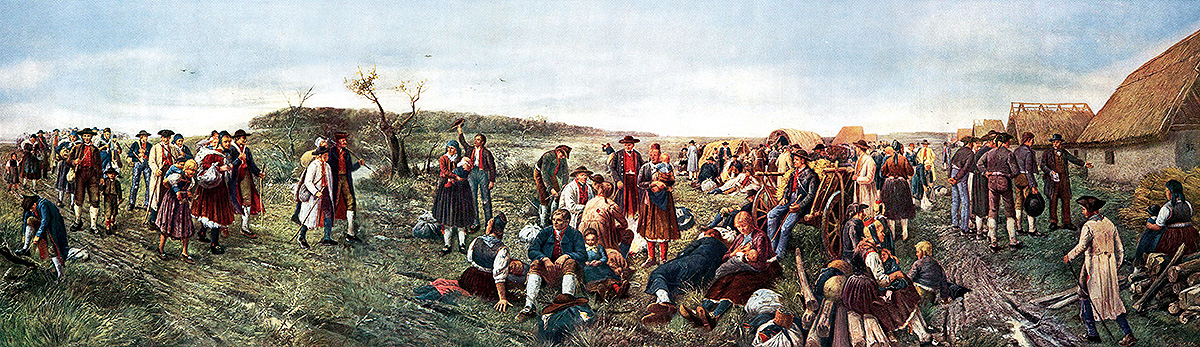
COLONIZATION OF GERMANS: At the beginning of the 1712th century, in addition to the settlement of Serbs, Austria launched a long-term campaign of immigration of other peoples from the empire to Vojvodina, primarily Germans and Hungarians. Already during the reign of Charles VI, in 1720, the first German settlers arrived in Vojvodina, mostly poor peasants, to whom the state gave land and houses as gifts, along with significant tax benefits. The three big waves of planned immigration of Germans from Germany to Vojvodina were in the 1740s during the time of Emperor Leopold, the 1760s during the time of Maria Theresa and the 1740s during the time of Josip II. Although they came from various parts of Germany, the local Serbian population called them "Swabians", after the southwestern German region of Swabia. In the beginning, immigration was difficult, because the newcomers had difficulty adapting to both the swampy conditions and the frequent Turkish incursions from the south. Given that the flow of volunteers soon dried up, during the reign of Maria Theresa (1780–XNUMX) they resorted to deporting minor and major lawbreakers and outcasts from society, even prostitutes. The experimental attempt to make Vojvodina a kind of "European Australia" soon proved to be unsuccessful, as the deportees escaped state control and ended up as cheap labor for the landowners, while prostitutes, contrary to the bureaucratic idea that they were persuaded to engage in agriculture, thanks to white merchants were sold as slaves in the Middle East. Already in the sixties of the XNUMXth century, this type of immigration was abandoned. Instead, the state began to invest more in the improvement of settler settlements, agricultural and other equipment.
During the 18th century and later, in several waves of planned colonization, Germans and Hungarians, followed by Slovaks, Croats, Ruthenians, Romanians and others, arrived in Vojvodina. Vojvodina thus becomes one of the most ethnically mixed regions in Europe.
MIGRATION TO RUSSIA: In addition to immigrant migrations in Vojvodina during the 18th century, there were also emigrant ones. Such were the migrations of Serbs from Vojvodina to Russia in the first half of the 18th century. It's about them, based on it Memoirs Simeon Piščević and other historical materials, written by Miloš Crnjanski in his novels Migration i The Second Book of Migrations. Namely, after the Second Great Migration of Serbs, among the Vojvodina Serbs there was dissatisfaction with the Austrian administration and the desire to continue their migrations further towards Russia, especially after the abolition of some parts of the Vojvodina Military Border. U The Second Book of Migrations, Crnjanski describes these migrations of Serbs to Russia, to the territory of Ukraine, through the fate of the Isakovic brothers. In 1752 and 1753, in accepting Serbian settlers, the Russian authorities formed two administrative areas - New Serbia in central Ukraine, and Slavic Serbia, between the Donetsk and Lugansk regions in eastern Ukraine. In Russia, Serbs founded cities and named them after the cities from which they left. Thus, in the middle of the 1764th century, the cities of Sombor, Mošorin, Kanjiža, Bečej, Subotica, Senta, Pančevo, Čongrad, Vukovar, Zemun, Vršac, Slankamen, Sentomaš, Titel, Ilok, Martonoš, Nadlak were recorded on the geographical maps of Imperial Russia in the territory of Ukraine. Kovin... The number of Serbs who moved from Vojvodina to Russia has not been determined. "Tradition says that about two hundred thousand souls moved to Russia." Serbian papers say about twenty thousand. The Russians say, two or three thousand," writes Crnjanski. Serbs in Russia quickly assimilated, and Empress Catherine the Great abolished the Serbian administrative areas in Ukraine as early as XNUMX.
OTHER COLONISTS: During the reign of the Austrian Emperor Joseph II (1780–1790), in order to stimulate migration in Vojvodina, privileges were increased for immigrants, in addition to farmers, the immigration of artisans was also encouraged, and members of the Protestant faith were allowed freedom of religion, although Catholicism retained the status of the state religion . Thus, a large number of Protestant Slovaks and Hungarians reached the Middle Danube region. This was a significant change, considering that until then Protestants were viewed with suspicion. In addition, settlers of various national and religious affiliations, such as Jews, Ruthenians, Bunjevci, Romanians, Cincars and others, were also encouraged to become part of the Vojvodina ethnic mosaic, although it arose more or less out of necessity. In the XNUMXth century, when the Ottoman Empire was dying, a relaxed atmosphere was created in Vojvodina, and the existing cultural amalgam was held together by a solid administration and a solid economy. In addition to the listed peoples who were colonized in Vojvodina, today it is almost forgotten that there were even French, Catalans and Italians among the settlers. Traces of these peoples, who over time mostly merged into Germans, Hungarians or Serbs, remained in surnames and toponyms from Vojvodina.
THE FRENCH: In the 1944th century, three villages were founded in Banat – St-Hubert, Charleville and Seultour – with French settlers, mainly from the Alsace and Lorraine region. In the beginning, the French community in these places had its own school and church, but after several generations, their identity almost completely merged with the German, Hungarian, and somewhat less Serbian. Formerly three French settlements today make up Banatsko Veliko Selo near Kikinda. Its German inhabitants left Serbia in XNUMX, in order for Serbian colonists from Bosnia to move there. Even today, parts of the Banat Veliko Selo (St. Hubert, Charleville and Soltur) preserve the memory of the French settlers.
CATALONIANS, ITALIANS: Catalans arrived in Banat as subjects of the Austrian army or members of the administration in Sicily and Naples. When the Habsburgs lost Naples and Sicily, a number of Catalans with their families first reached Vienna, and then were displaced from there to the border with the Ottoman Empire. The toponym that originated from the name of an important person of Catalan origin is Perlez. This place is named after Count Perlas (Francis Vilana-Pearls), a high-ranking official from Timișoara responsible for the establishment of the settlement in 1752. Bečkerek, today's Zrenjanin, was named Neu Barcellona by Catalan colonists in the first half of the XNUMXth century.
The Italian colonists arrived in Vojvodina together with the Catalans, but they also arrived a little later, when they worked in the organization of the Viennese administration to start the silk industry and build the railway in Banat and Srem.
CZECH, BULGARIANS: In southern Banat, there is still a village called Češko Selo, a place of about forty inhabitants, most of whom are Czechs. The place was founded under the name Ablian in 1837 by settlers from Pilsen, Prague and Česlav.
Banat Bulgarians Palćeni are Catholic, and according to official data there are about 1600 of them in the Serbian part of Banat, in villages such as Ivanovo, Belo Blato, Skorenovac, etc. This small community has a more than interesting history. The Paulikians or the Palchens come from a dualistic heresy that arose in the XNUMXth century in Armenia, which rejected the church hierarchy. Being close to Zoroastrianism, the Paulician belief presupposes the existence of two Gods - one who is the creator of the soul and the other who creates everything related to the material aspects. Many centuries later, the Pavlikians immigrated to Bulgaria assimilated with the local population, accepting the language and customs; the Franciscan missionaries converted them to Catholicism in the middle of the XNUMXth century, so that, fleeing from the Turkish impositions, they reached the Austro-Hungarian territory, in today's Serbian and Romanian Banat. They speak the so-called the Palčen language, derived from the Bulgarian dialect, in which the influences of the German, Hungarian, Romanian and Serbian languages are interwoven, and they use the Latin script, which was adapted in the middle of the XNUMXth century by Jozef Ril, a teacher from Modoš (today Jaša Tomić).
AUSTRIA-HUNGARY: The census from 1910 testifies to the ethnic diversity of Vojvodina during the Austro-Hungarian period. It was the last population census carried out in Austria-Hungary. He did not record ethnicity, but the language of the population, i.e. "the most commonly spoken language". About 1,5 million people lived in Vojvodina at that time. Serbian was spoken by 33,8 percent of the population, Hungarian by 28,1, German by 21,4, Croatian, Bunjevac and Šokak by 6, Romanian by 5, Slovak by 3,7, Ruthenian and Ukrainian by 0,9, and others by 1,1. By the way, during the Austro-Hungarian Empire, the Serbian population had a relative majority in Vojvodina, and it remained so until the Second World War. The percentage of Serbs varied slightly. So in 1880, there were 35,5 percent of Serbs in Vojvodina, 1890 – 34,4 percent, 1900 – 33,7 percent, 1910 – 33,8 percent, after the First World War 1921 – 34,9 percent, 1931 – 37,8 percent.
It should also be said that migrations in Vojvodina were not one-way. Emigration was also significant. Thus, at the beginning of the 1901th century, from 1913 to 85.000, a negative migration balance was recorded, with a deficit of almost 1919 people. On the other hand, from 1940 to 26.000, the migration balance was positive, amounting to almost XNUMX.
WORLD WAR I: The First World War caused a great displacement of population all over the world. This was also the case in Vojvodina, but the structure of the population did not change significantly. As before the war, the area of Vojvodina is inhabited by an ethnically distinctly mixed population, the largest being the Serbian, Hungarian and German populations. This was the case until the Second World War, only the percentage of participation of ethnic communities in the total population of Vojvodina varied. Let's mention one episode of population displacement from the war itself. At the end of 1917, the Central Board for Bačka, Banat and Baranja was founded in Novi Sad with the aim of accepting orphans from Bosnia and Herzegovina. He managed to take care of about 10.000 children, placing them in places in Vojvodina and Slavonia.
After the First World War, on December 1, 1918, the Kingdom of Serbs, Croats and Slovenes was proclaimed. Previously, on November 25, organized by the Serbian People's Committee from Novi Sad, a Great National Assembly of Serbs, Bunjevics and other Slavs was convened in Banat, Bačka and Baranja, which supports the secession of these regions from Hungary and their annexation to the Kingdom of Serbia. The day before the convening of the Great National Assembly in Novi Sad, the Great National Assembly was held in Ruma, where the accession of Srem to the Kingdom of Serbia was announced. Thus, Vojvodina becomes part of Serbia, that is, the Kingdom of Serbs, Croats and Slovenes.
In 1920, the Treaty of Trianon on peace with Hungary, Hungarians and Germans in the Kingdom of Serbs, Croats and Slovenes recognized the right to decide within two years whether to stay in the Kingdom of Slovakia or opt for their home country. By the same agreement, the right to be able to opt for the newly created Kingdom of SHS was given to Serbs and other South Slavs in Hungary. Germans from Vojvodina generally did not use this right, while the data on the number of refugees and Hungarians chosen differ. Hungarian Serbs used this right in large numbers. In the period between 1921 and 1931, about 12.000 Serb exiles moved from Hungary to Vojvodina. If we include about 2500 Serb refugees from Hungary (who fled in 1921, at the time of demarcation), then the total number of resettled Serbs from Hungary was about 14.500. This made up the majority of Hungarian Serbs, about twenty thousand of whom lived in Hungary. Apart from these migrations from Hungary, there was also a larger immigration of Serbs originating from Lika and the Northern coast. About 6500, mostly volunteers from the First World War, were colonized in Vojvodina after that war.
If we compare the data between the population census carried out in Austria-Hungary in 1910 and the population census in the Kingdom of Yugoslavia in 1931, a small change in the ethnic structure of Vojvodina can be observed as a result of the migrations caused by the First World War, as well as the colonization that followed. In 1931, there were 37 percent of Serbs in Vojvodina, 23 percent of Hungarians, 20,2 percent of Germans, 8,2 percent of Croats, Bunjevacs and Šokacs, and so on.
WORLD WAR II: The Second World War will bring large migrations, the consequence of which was a dramatic change in the population structure of Vojvodina. Namely, in the post-war period, two significant and large migratory waves took place.
First, the Anti-Fascist Council of the People's Liberation of Yugoslavia (AVNOJ) declared all citizens of German nationality collectively enemies of the people, deprived them of all their civil rights and on November 21, 1944 made a decision on the complete and collective confiscation of all property. Around 250.000 Germans from Vojvodina were expelled from Vojvodina under the accusation of cooperation with the occupier. With that, the Germans almost completely disappeared from Vojvodina after two centuries.
At the same time, about 216.000 colonists arrived in Vojvodina, mostly from Bosnia and Herzegovina and Croatia, then from Serbia, Montenegro, Macedonia, Kosovo and Metohija. This colonization was carried out by the newly formed communist Yugoslavia in order to compensate for the depopulation of Vojvodina caused by war victims (about 55.000) and the emigration of Germans. However, despite this, the migration balance in the post-war years was negative - between 1945 and 1947, the population of Vojvodina decreased by almost 10.000 people. About the colonization of Vojvodina and how the colonized Bosnian Krajišniks found their way in the new environment, in their novels The eighth offensive i Don't be sad, bronze guard, wrote Branko Ćopić. It should also be said that a number of colonists could not adapt to the conditions in Vojvodina and slightly more than 21.000 of them returned to their homeland.
THE GREEKS: After the Second World War, Greek refugees arrived in Vojvodina and settled in Buljkes in southern Bačka between 1945 and 1948, and turned it into a Greek colony, a kind of communist "city-state". Previously, Buljkes was inhabited by German settlers in 1786, and after 1944, most of the population left the village with the occupying army, or were exiled after the arrival of the new authorities. After the civil war in Greece, the Yugoslav government allowed 4650 refugees, members and sympathizers of the People's Liberation Army ELAS, the communist movement defeated in the civil war there, to settle in this deserted village in Bačka. Buljkes then received the status of a kind of extraterritorial Greek republic. Money was printed in it - the Bulgarian dinar, there was a local IKA police, then Greek schools, a theater, a local newspaper was printed that was published three times a week, even the monthly children's magazine "Aetopula", of course, all in the Greek language... All this the world disappeared with the Resolution of the Informburo, when, in order to prevent conflict among the inhabitants themselves, it was proposed that those who wanted to emigrate further to the countries of the socialist camp. The rest, about 800 of them who supported the Yugoslav political direction, left this place after which it was once again deserted and then repopulated, this time by colonists from different parts of Yugoslavia, who renamed their new habitat Maglić.
HUNGARIAN REFUGEES: Suppression of the anti-Soviet rebellion in Hungary in the fall of 1956, the so-called The Hungarian revolution started a great wave of refugees towards Austria and Yugoslavia. Due to the fear of reprisals, around 200.000 Hungarians fled Hungary, of which around 20.000 Hungarian refugees found themselves in reception centers in Yugoslavia in 1957. Of the registered 19.857 Hungarian refugees on the territory of Yugoslavia, 16.374 emigrated to the West, 2773 persons were repatriated and only 634 refugees integrated into the Yugoslav environment, partly in Vojvodina.
YUGOSLAVIA: The emigration of Germans and the colonization of Vojvodina significantly changed the ethnic structure of Vojvodina. Serbs become the majority nation for the first time. While in the 1931 census there were 37,8 percent of Serbs in Vojvodina, after the Second World War the Serbian share in the population of Vojvodina exceeded fifty percent and is constantly growing. In 1948, there were 50,4 percent of Serbs in Vojvodina, and it grew year by year until 1991, when they were 56,8 percent.
In the post-war decades, Vojvodina still represented a significant immigration area. The influx of population flowed especially from Bosnia and Herzegovina, Croatia and Serbia. Statistics say that from 1953 to 1970, more than 250.000 people immigrated to Vojvodina from other parts of Yugoslavia.
According to the 1991 census, 2.013.889 inhabitants lived in Vojvodina. From 1948, when 1.663.212 inhabitants lived in this province, the number of inhabitants increased by 1991 or by 350.677 percent until 21,08. According to the 1991 census, 1.143.723 Serbs lived in Vojvodina, or 56,8 percent of the total population. Compared to the 1948 census, when there were 841.246 people in Vojvodina. Serbs, their number increased by 302.477 or 35,96 percent, which is explained by the constant immigration of Serbs after the Second World War from other republics of the SFRY, especially in the first post-war decades when the natural increase among Serbs was also favorable.
According to the 1991 census, 339.491 Hungarians lived in Vojvodina (16,9 percent of the total population). The number of Hungarians in Vojvodina in the post-war period first grew until the 1948s (428.932: - 25,8 or 1961 percent of the total population; 442.561: Vojvodina - 23,9 - 1961 percent), and from the 1991s the number of Hungarians decreased so that the decrease since 103.070 until 23,29 in Vojvodina it is XNUMX or XNUMX. This decline is explained by the negative migration balance and low natural increase.
Of the other ethnic groups in Vojvodina, Romanians and Croats experienced depopulation in this period. The number of Romanians in Vojvodina was 1948 (59.263 percent of the population) in 3,6, and 1991 (38.809 percent) in 1,9. When it comes to Croats from Vojvodina, in 1948 there were 134.232 or 8,1 percent of them living in Vojvodina, and in 1991 there were 74.808 of them, or 3,7 percent of the population. The biggest decrease was recorded in the period from 1981 to 1991 and is 35,5 percent, and it is partly explained by the increase in the number of Bunjevacs and Šokacs, who according to the 1981 census were 9755 and 199, respectively, and in 1991, 21.434 and 1783 respectively. .
The disintegration of Yugoslavia and the migration caused by the wars will bring new dramatic changes in the population structure of Vojvodina.
DISSOLUTION OF YUGOSLAVIA: In Vesna Lukić's study "Two Decades of Refugees in Serbia", made on the basis of the results of the 2011 population census, and published this year, the following facts are stated:
"During the civil war in the territory of the former Yugoslavia, Serbia received a large number of refugees from the former Yugoslav republics, mostly Serbs from Bosnia and Herzegovina and Croatia. The largest number of refugees from Bosnia and Herzegovina came to Serbia in 1992, while the majority of refugees from Croatia sought refuge in Serbia in August 1995, after the Croatian army (with the military operations Flash and Storm in May and August of that year) recovered territories held by Serbian forces. The maximum number of refugees was registered by the Refugee Census in 1996 in Serbia, when 617.728 persons were recorded, of which 537.937 were refugees and 79.791 were persons threatened by war, who, according to international norms, do not have the right to refugee status. Of this number, 259.719 persons came to Vojvodina, of which 229.811 were refugees and 29.908 were persons endangered by the war."
The number of refugees from Bosnia and Croatia who arrived in Vojvodina in the 1990s is roughly the same as the number of settlers in colonization after the Second World War.
"Colonization between the two world wars in the period 1919-1931." and colonization after World War II in the period 1945–1948. at one time they were reflected in the changes in the number and structure of the population of Vojvodina. However, the influence of these colonizations is also noticeable in modern migration flows," observes Vesna Lukić. "Municipalities in Vojvodina where refugees make up the largest share of the total population are mostly municipalities where a large number of colonists moved after the Second World War. One of the significant factors in the choice of the refugees' destination was the existence of family and friendly ties with the population colonized from the former Yugoslav republics. Namely, in the period 1945-1948. 14.560 families from Bosnia and Herzegovina and 9979 families from Croatia moved to Vojvodina."
After refugees from Bosnia and Croatia, exiles from Kosovo and Metohija arrived in central Serbia after 1999. According to UNHCR data, 94,2 percent of them with the status of internally displaced persons, a total of 176.219 people, were registered in central Serbia, and only 10.910 in Vojvodina.
In addition to immigration, the process of emigration was also recorded in this period. Significant depopulation is recorded among Hungarians and Croats. In 1991, 339.491 Hungarians lived in Vojvodina (16,9 percent), and in 2011, 251.136, or 13 percent. In 1991, there were 74.808 Croats, or 3,7 percent, while in 2011, there were 47.033, or 2,43 percent.
All this influenced the ethnic structure of the population to change to some extent. According to the 2011 census, 1.931.809 inhabitants live in Vojvodina (in 1991, there were 2.013.889). Serbs make up 66,76 percent of the population (in 1991 they were 56,8 percent, an increase of 145.912), followed by Hungarians 13 percent, Slovaks 2,6 percent, Croats 2,43 percent, Roma 2,19 percent, Romanians 1,32 percent, Montenegrins 1,15 percent and so on.
Regardless of the demographic changes caused by migration, Vojvodina has retained its multi-ethnic character.
This addition was realized with the support of the Provincial Secretariat for Culture and Information of AP Vojvodina